I just wanted to do a quick test to see how the expressionistic style would turn up with the distorted windows and the complex texture.
Showing posts with label adaptation. Show all posts
Tuesday, 1 April 2014
Tuesday, 11 March 2014
Adaptation Part B: Approach Idea
Following my feedback during the Interim Crit, I was told that I have to keep asking my self whether the composition and overall mood of it reflects the keywords from the extracts.
This gave me the idea to take a different approach and find ways to reflect the mood through the use of space. Surrealism came to my mind.
The reason I am taking this approach, is to free my self from the constraints of a normalised point of view/ perspective and bring a different perspective into the "normal life"
This gave me the idea to take a different approach and find ways to reflect the mood through the use of space. Surrealism came to my mind.
The reason I am taking this approach, is to free my self from the constraints of a normalised point of view/ perspective and bring a different perspective into the "normal life"
I feel that Surrealism is a good way to make the marginalised elements stand out.
For instance, focusing on the keywords from the chosen extracts will help emphasis their importance in the environment.
Surrealism is a movement which emerged in Europe in the early 20th Century.
Some of the most important figures in Surrealism are: Andre Breton as the founder of the movement, Max Ernst, Rene Magritte and Salvador Dali.
An attempt to meet the moral challenges of modern life and opening the door to new ways of experiencing life and reality.
It is often considered as a way of marrying the conscious and unconscious states, therefore creating an intersection between the real and the fantastic.
The process of surreality involves uncertainty, mystery and doubts.
"Surreality is to take one step into uncertainty, while still remaining safely grounded in known reality. One takes what is situated in a familiar scenery and moves into the unknown, without ever losing connection between the two. Surreality is created as a between place, like a stream or river becoming the bridge between reality and fantasy. It is not a frozen perception or a finished product. It is not scenery captured through the camera lenses, but rather constant movement that makes it possible to perceive into a new kind of activity." Nozomi Hayase
It seems that there is a thin line between fantasy and surreality, meaning that one must be careful to keep familiar scenes when bringing in surreal elements.
Adaptation Part B: Update
Initial thumbnails:
Collages after taking a different approach in order to come up with more interesting compositions:
Wednesday, 19 February 2014
Adaptation Part B: Extracts and Response
As an initial step, I have decided to quickly respond to the following extracts in order to understand the mood of them through Abstract form and Expressionism.
Below are my visual interpretations of the chosen extracts:
"The old established inhabitants of the city kept away from that area where the scum, the lowest orders had settled- creatures without character, without background, moral dregs, that inferior species of human being which is born in such ephemeral communities." P.70
Below are my visual interpretations of the chosen extracts:
"The old established inhabitants of the city kept away from that area where the scum, the lowest orders had settled- creatures without character, without background, moral dregs, that inferior species of human being which is born in such ephemeral communities." P.70
(Watercolour, Ink and Masking tape on paper)
"Everything seemed suspect and equivocal there, everything promised with secret winks, cynical stressed gestures, raised eyebrows, the fulfilment of impure hopes, everything helped to release the lowest instincts from their shackles" P.71
(Ink and Watercolour on paper)
"Reality is as thin as paper and betrays with all its cracks its imitative character." P.73
(Photoshop)
" An atmosphere of strange insignificance pervades the scene. The crowd flows lazily by, strange to say, one can see it only indistinctly; the figures pass in gentle disarray, never reaching complete sharpness of outline." P.73
(Graphite on paper)
" Let us say it bluntly: the misfortune of that area is that nothing ever succeeds there, nothing can ever reach a definite conclusion. Gestures hang in the air, movements are prematurely exhausted and cannot overcome a certain point of inertia. " P.76
"Over the whole area there floats the lazy licentious smell of sin, and the houses, the shops, the people seem sometimes no more than a shiver on its feverish body, the gooseflesh of its febrile dreams. Nowhere as much as there do we feel threatened by possibilities , shaken by the nearness of fulfilment, pale and faint with the delightful rigidity of realisation." P.76
" We shall get involved in misunderstandings until all our fever and excitement have spent themselves in unnecessary effort, in futile pursuit." P.76
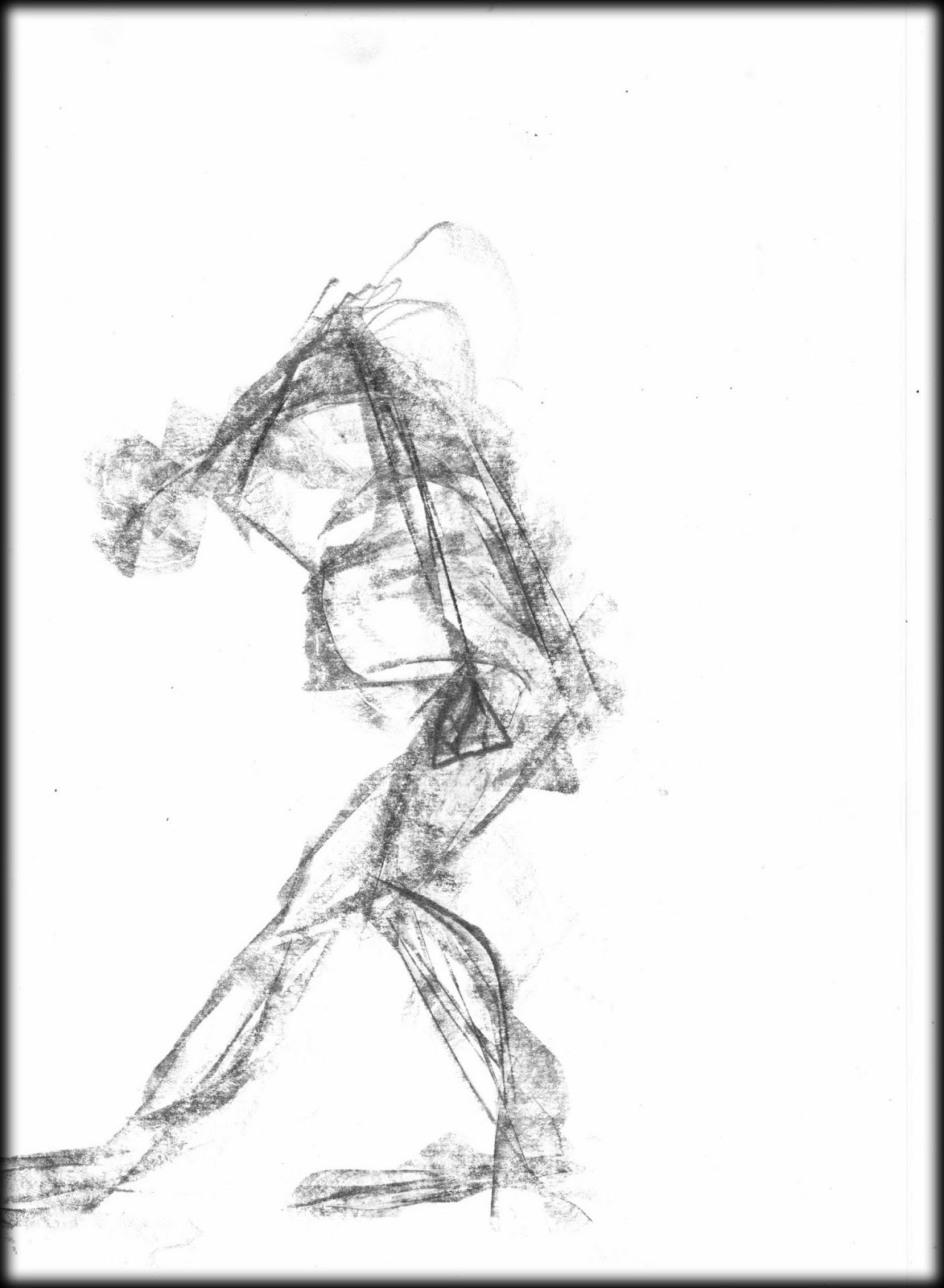
Concerning the last three extracts, I have imagined them as characters who are exhausted by the atmosphere, they reflect on their vicinity and vice versa.
(Graphite on paper)
Adaptation Part B- Source and Goal
For the rest of the year, I will adapt The Street of Crocodiles by Bruno Schulz.
Bruno was a Polish writer and fine artist, regarded as the leading writer between WW1 and WW2 as well as one of the greatest prose writers in 20th Century Poland.
The Street of Crocodiles is a short story in which he shares his childhood memories through a remarkable mix of real and fantastic storytelling elements, as well as figures of speech such as metaphors.
Concerning the goal of the project, I will adapt extracts from the short story, through the story's mood and metaphors, into a Digital set.
The Digital set will be shown through different shots (camera pan, zoom..)
It will also have animated elements in it as well as using sounds and atmospheric effects (rain, sunrise, wind..) in order to bring the piece to life and make the viewer feel part of it.
Friday, 7 February 2014
Adaptation: Infographics- Update
This is a post to show the development of the infographic, a rough storyboard I did to quickly visualise my ideas and plan the transitions, as well as some initial faces designs and other objects in the animation:
Thursday, 23 January 2014
Adaptation: Infographic- Inital drawings/designs
Concerning my idea of the illusion, these drawings will make it a bit clearer:
The iceberg morphs into a face of an old man, in which the bottom bit of his face is the brain of the "real character" this is to show that the brain is the hidden part of the iceberg which will be explored, but the visible part which is the face ( Smile) is the brain of the old man, so his face will be then flipped 180 degrees in order for the drawing to make sense.
As I am going for a minimalist approach, I tried to experiment with the pen tool but found out I did not remember how to use it properly, so I have used the lasso tool just to quickly get an idea of the overall design, but I will go back to the pen tool for future designs.
The iceberg morphs into a face of an old man, in which the bottom bit of his face is the brain of the "real character" this is to show that the brain is the hidden part of the iceberg which will be explored, but the visible part which is the face ( Smile) is the brain of the old man, so his face will be then flipped 180 degrees in order for the drawing to make sense.
As I am going for a minimalist approach, I tried to experiment with the pen tool but found out I did not remember how to use it properly, so I have used the lasso tool just to quickly get an idea of the overall design, but I will go back to the pen tool for future designs.
I have also used one of my picture as a reference to understand what I need to include in the design in order to show a "Duchenne smile", meaning a real smile, in which the muscles around the eye wrinkle.
A quick study to understand the muscles involved in the smile:
Adaptation: Infographic- Script.v1
Following a problem on Scribd, failing to upload my script PDF, I will post it here:
THE SMILE
The smile is just like, uh, let's see, a house? no, no,
no, an undercover agent? Nooooo.
Em, how about an iceberg?
hm, yeah, the small visible part of the iceberg is the
smile but what's hidden is the most interesting part.
Before we smile a few things happen between 0.3s and
4seconds.
First, we sense, hear or see something and this take form
of an information.
Secondly, This information goes to the Temporal lobe in
which it gets processed.
Lateralisation occurs, this means, the left and right
temporal lobe communicate to absorb information such as
visual memories, sensory input and emotions.
Thirdly, this information gets planned and executed in a
Neural network called the Extrapyradimal system.
Alright, we are nearly ready to smile now.
I bet you are smiling already.
After the execution is done, the facial nerve transports a
signal to the face, more specifically, the Zygomaticus
Major and the Orbicularis Oculli.
Here we go, ready?
Finally, the corners of the mouth and cheeks are pulled
and the muscles around the eyes wrinkle.
Monday, 20 January 2014
Adaptation: Infographic- Transitions
Concerning the overall design and transition, I am going for a minimalistic style which I believe would make a nice contrast with the complexity of my idea " The timeline of a smile".
Below are some influences I will be considering during the production stage, such as using one point of focus and this point will lead from one stage of the animation to the other by using different continuous transitions such as Morph.
Adaptation: Infographic- Metaphor Ideas
For my info-graphic I want to use a metaphor to show how the smile "looks easy" and happens really quickly but in fact it's quite a complex action.
So after a talk with Phil, we agreed that an Iceberg is an interesting metaphor as it is very relevant to the "Smile" in terms of having a clear side and hidden side.
To make this metaphor more interesting I have thought of ways to show that the hidden side of the Smile is the brain and the face illusion idea came up.
I find it interesting in a way that it tricks the audience to believe that the first character's head is another's face and vice versa.
I will be soon uploading a storyboard which will make the idea clearer.
Below is an idea about using an undercover agent drawing to show how certain things could be hidden under a hat, taking the example of Inspector gadget.
So after a talk with Phil, we agreed that an Iceberg is an interesting metaphor as it is very relevant to the "Smile" in terms of having a clear side and hidden side.
To make this metaphor more interesting I have thought of ways to show that the hidden side of the Smile is the brain and the face illusion idea came up.
I find it interesting in a way that it tricks the audience to believe that the first character's head is another's face and vice versa.
I will be soon uploading a storyboard which will make the idea clearer.
Another idea was using a house as a character to show that the bottom bit (Attic) is the brain as it is place where past memories are hidden, and the rest of the house (minus the attic) is what you normally see and interact with, as no one want you to look at their attic.
Below is an idea about using an undercover agent drawing to show how certain things could be hidden under a hat, taking the example of Inspector gadget.
I really like the first idea and will take it further to a storyboard.
Wednesday, 15 January 2014
Adaptation: Infographic- Visual Influence
Concerning the style I am going for, I am thinking of a simplistic style in order to effectively communicate my idea, however I am thinking of incorporating some sort of metaphor of my idea into the design, this could be seen in the work of these artists especially Paul's and Rowan's designs.
Paul Tebbott: An English designer whose work is characterised by the use of bright eye catching colours and simple style.
Saul Bass: An American Graphic designer, most famous for his minimalistic style.
Rowan Stocks-Moore: A Graphic designer famous for Disney posters:
Paul Tebbott: An English designer whose work is characterised by the use of bright eye catching colours and simple style.
Saul Bass: An American Graphic designer, most famous for his minimalistic style.
Rowan Stocks-Moore: A Graphic designer famous for Disney posters:
Other Designs:
Monday, 13 January 2014
Adaptation: Infographic- Timeline
Using the information I gathered through the research, I have tried to breakdown the action into simplified and clearer actions to help better visualise my idea by creating a simple timeline to show the chronology of the action. However there is no exact duration of the action, it ranges from 0.3 seconds to 4 seconds which I assume is due to the processing speed of the data by the brain during the second phase.
I still need to figure out the timing within the action as it is not clear and might need further research.
The next step will be deciding on the visual style, fonts and transitions.
I still need to figure out the timing within the action as it is not clear and might need further research.
The next step will be deciding on the visual style, fonts and transitions.
Adaptation: Infographic- Research
For my idea, the timeline of an action seemed very interesting, in terms of breaking down a very short action (Smile) into smaller actions.
Smile seemed like a very powerful expression to me as it happens very quickly but means a lot.
Its universal trait makes it easy to be shared and recognised. It is a way to communicate joy, love or laughter. It has the power to change people's mood in less than a second.
When researching, it took me a while to find out the process of Smiling as it is a very complex action yet fascinating.
- Smiling is an action to
transmit information, which can be received, read and interpreted differently
by some cultures.
It usually starts in one the sensory areas of the brain triggered either by a sound, a feeling or a visual, where the neuronal signals travel to the brainstem.
This information is processed in the Temporal lobe, a region of the cerebral cortex, which allows communication between the left and right temporal lobe and between the occipital, parietal and frontal lobes of the brain. This helps retention of visual memories, facial recognition, sensory input, language comprehension, new memory storage and emotions.
After this, the information is planned; controlled and executed in the extrapyramidal system, a neural network which is responsible for involuntary reflexes and movements.
The cranial nerve (Facial nerve) transports a signal towards the central part of the face (smile muscle).
Once the nerve fires, the corners of the mouth (Zygomaticus major) and cheeks are pulled up, and then if the smile is real, a facial nerve activates small muscles around the eye, which causes wrinkling around the eyes (Orbicularis Oculi).
Smile seemed like a very powerful expression to me as it happens very quickly but means a lot.
Its universal trait makes it easy to be shared and recognised. It is a way to communicate joy, love or laughter. It has the power to change people's mood in less than a second.
When researching, it took me a while to find out the process of Smiling as it is a very complex action yet fascinating.
In a recent research scientists concluded “that smiling can be as
stimulating as receiving up to 16,000 Pounds Sterling in cash.”
However it is viewed as a friendly sign across most cultures.
The
entire event is short, it lasts from two-thirds of a second to four seconds.
It seems to be an easy expression, which is characterized by a rise of the corners of the mouth, lifting of cheeks and crinkle of eyes.
In short, scientists have learned that one of humanity’s simplest expressions is beautifully complex.It usually starts in one the sensory areas of the brain triggered either by a sound, a feeling or a visual, where the neuronal signals travel to the brainstem.
This information is processed in the Temporal lobe, a region of the cerebral cortex, which allows communication between the left and right temporal lobe and between the occipital, parietal and frontal lobes of the brain. This helps retention of visual memories, facial recognition, sensory input, language comprehension, new memory storage and emotions.
After this, the information is planned; controlled and executed in the extrapyramidal system, a neural network which is responsible for involuntary reflexes and movements.
The cranial nerve (Facial nerve) transports a signal towards the central part of the face (smile muscle).
Once the nerve fires, the corners of the mouth (Zygomaticus major) and cheeks are pulled up, and then if the smile is real, a facial nerve activates small muscles around the eye, which causes wrinkling around the eyes (Orbicularis Oculi).
The scientific analysis of the smile goes back to 1860s, when the French anatomist Guillaume Benjamin Amad Duchenne de Boulogne used electrical currents to make facial muscles contract and believe that through studying the muscles underlying facial movement we could gain insight into how the face expresses emotions.
For instance, after the electrical simulation,
the recorded expressions show that a true smile is characterised by wrinkling
of the muscle around the eyes (Orbicularis
Oculi) (B), this means that the mouth and cheeks muscles obey without problem
but the eye needs a true feeling to be activated.
Opposed to the true smile, the fake smile is considered as a voluntary action; therefore the signal takes a different route. The Motor cortex is the region responsible for voluntary actions and movements.
Subscribe to:
Posts (Atom)